What does investable climate adaptation look like in practice? ADAPT-FIN will work across nine real-world cases in six European countries to find out.
Climate adaptation does not look the same everywhere.
For one city, resilience may mean using nature-based solutions to address extreme heat and flooding. For an agricultural business, it may mean protecting soils and productivity against drought. Elsewhere, it can involve reducing landslide risk, adapting coastal landscapes to salinity or recognising the economic value of ecosystem services.
This diversity is why real-world case studies are at the centre of ADAPT-FIN.
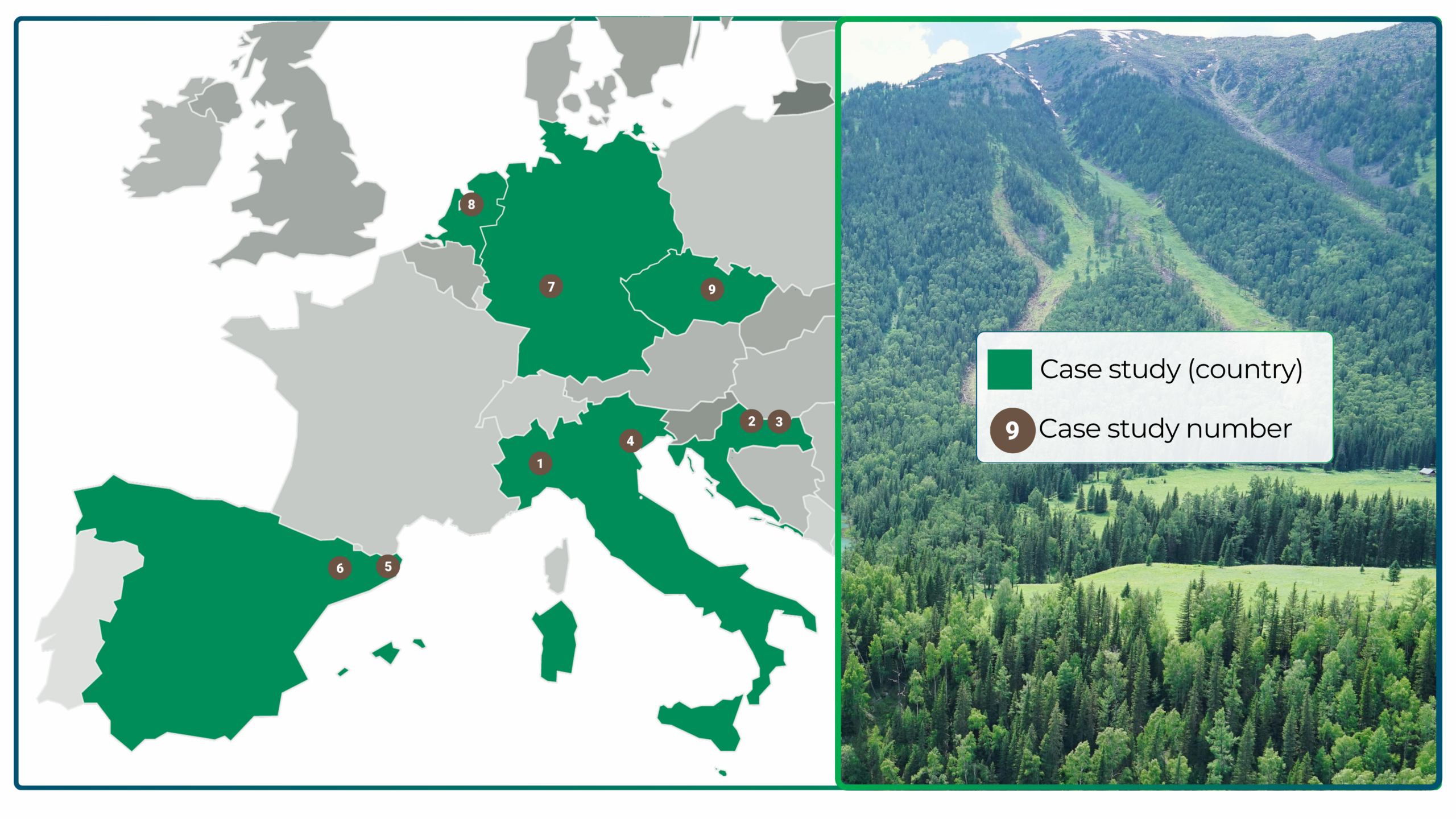
Across Italy, Croatia, Spain, Germany, the Netherlands and Czechia, nine cases will provide the environments in which the project’s economic approaches, incentive mechanisms and investment concepts can be tested, challenged and improved.
Nine different pathways to resilience
The ADAPT-FIN cases cover a broad range of adaptation challenges:
Turin, Italy — Torino Climate Living Lab
Nature-based solutions will be explored to address urban challenges, including heat, pluvial flooding, and drought.Krapina-Zagorje, Croatia — Landslides Living
Lab
The case focuses on strengthening resilience to landslide risk.Northwest Croatia — Biosolar Roofs for Climate-Resilient
Public Buildings
The project will explore biosolar roofs as an adaptation solution for public infrastructure.Venice Lagoon, Italy — Coastal Salinity
Adaptation
Halophyte-based solutions will be investigated as part of a resilient coastal bioeconomy.Catalonia, Spain — Nature-based Solutions for Flash
Floods
The case will examine how nature-based approaches can strengthen flood resilience and create replicable investment models.Spain — Regenerative Agriculture
Five commercial farms—two olive groves, two vineyards and one pasture system—will test regenerative practices designed to strengthen soil health, productivity and resilience to drought and heat.Germany — Nature Investments in Agricultural Supply
Chains
The case explores how nature investments can be recognised as climate adaptation assets within agricultural value chains.Netherlands — Ecosystem Services in Dutch
Watersheds
The project will explore approaches for recognising and translating ecosystem services into investment value.Czechia — Agroforestry for Climate
Adaptation
Building on the ReForest Czech Living Lab networks, the case will explore scalable, finance-ready agroforestry practices.
More than demonstration sites
The cases are not simply places where ADAPT-FIN will showcase finished solutions. They are the project’s testing ground.
Case Study Leaders will work with local stakeholders and private-sector actors to apply the cost–benefit approach, calculate the economic rationale for adaptation, co-design context-specific incentives and explore appropriate financial mechanisms.
Each case will then translate this work into a validated Investment Roadmap.
These roadmaps are intended to help adaptation solution providers understand how their solutions can progress towards investment readiness, connecting evidence about climate and economic benefits with business models, incentives and the expectations of potential investors.
Across the nine cases, ADAPT-FIN will therefore be asking a common question:
How can a valuable adaptation solution become an investable one? By answering that question across different sectors, hazards and European contexts, the project aims to develop approaches that can be replicated well beyond the original nine cases.
Follow ADAPT-FIN as we work to make resilience investable!